With KUMANO XR at the core, extending into the Jabara Shrine, Gastronomy, and the Retreat. The four lights are bound by one brand sensibility — "Translating Japan to the world."
Translating the lost landscape.
In the Totsukawa Great Flood of 1889 (Meiji 22), Kumano Hongū Taisha was swept away from Ōyunohara. The solemn ground where twelve shrine halls once stood remains today as the great torii, a stone monument, and a vast field of grass.
Guji Kuki has stated that the physical reconstruction of the original halls is "not feasible." And yet, the lost landscape of Ōyunohara — which for over a thousand years has sustained the spiritual rebirth of the Japanese soul —「失われた風景」is there a way for us, today, to experience it once more? KUMANO XR is one answer to that question.
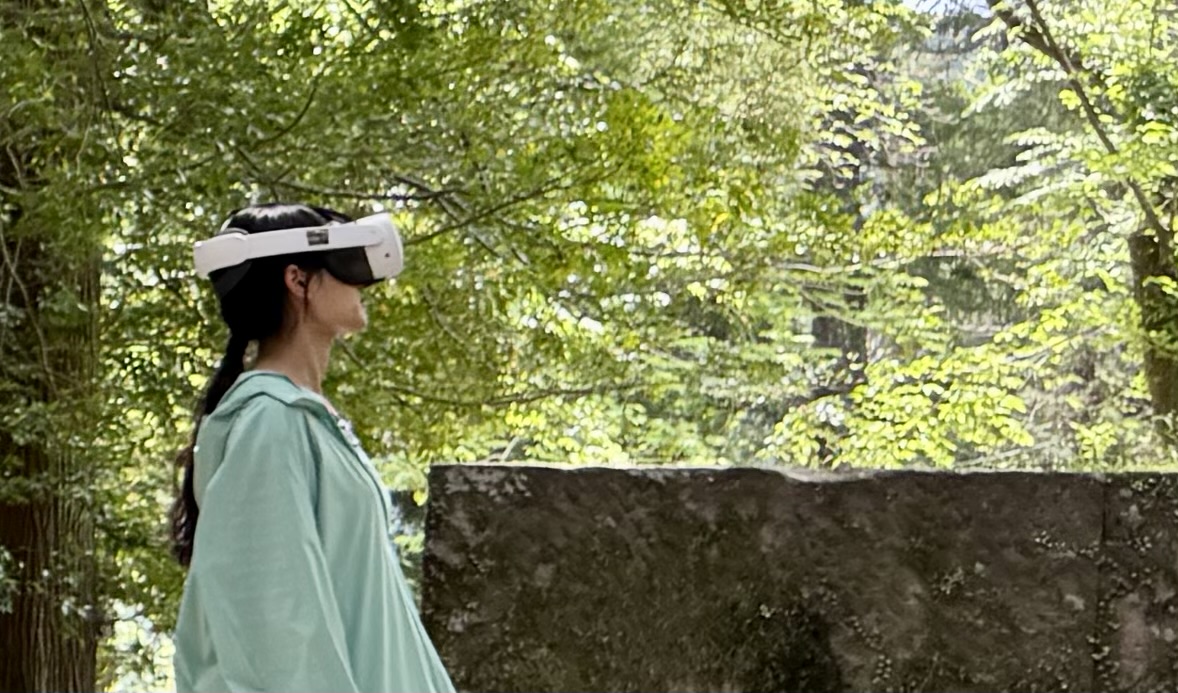
Through the latest XR technology, participants wear an HMD and walk on the ground of Ōyunohara, experiencing a hybrid XR in which MR and VR transition seamlessly —「ハイブリッドXR」. For about twenty minutes, guided by Yatagarasu, participants trace the myth of Emperor Jimmu, the imperial procession of Retired Emperor Go-Shirakawa, the original Hongū, the collapse of 1889, and the present-day yomigaeri — as one continuous story.
This is not a tourist attraction. It is a cultural endeavour — translating a thousand years of prayer, loss, and renewal through the technology of today.
Yatagarasu appears in MR, announcing the beginning of the journey.
The myth of Emperor Jimmu and the guidance of Yatagarasu are told.
In MR, pilgrims of old pass before your eyes.
The twelve shrine halls rise before you.
Retrace the pilgrimage of the retired emperor, who visited Kumano more than thirty times.
The historical moment when the shrine halls are swallowed by the waters and swept away.
Back in the present, the halls are digitally revived.
Carry the experience home as a story.
チケットは1名7,500円(税込)。価格の中には、本Projectsの根幹であるa structure for returning value to the region and to Kumano Hongū Taishaを組み込んでいます。
April 2027 (planned)
335 days per year (closed in rain and severe weather)
25–40 guests (reservation required)
Japanese, English, Mandarin, Korean
6–7 permanent core staff, plus 3–6 in peak seasons
Approx. 1.61 million annual visitors to Hongū-chō, Tanabe City (2024)
Translating the spirituality of the land onto the plate.
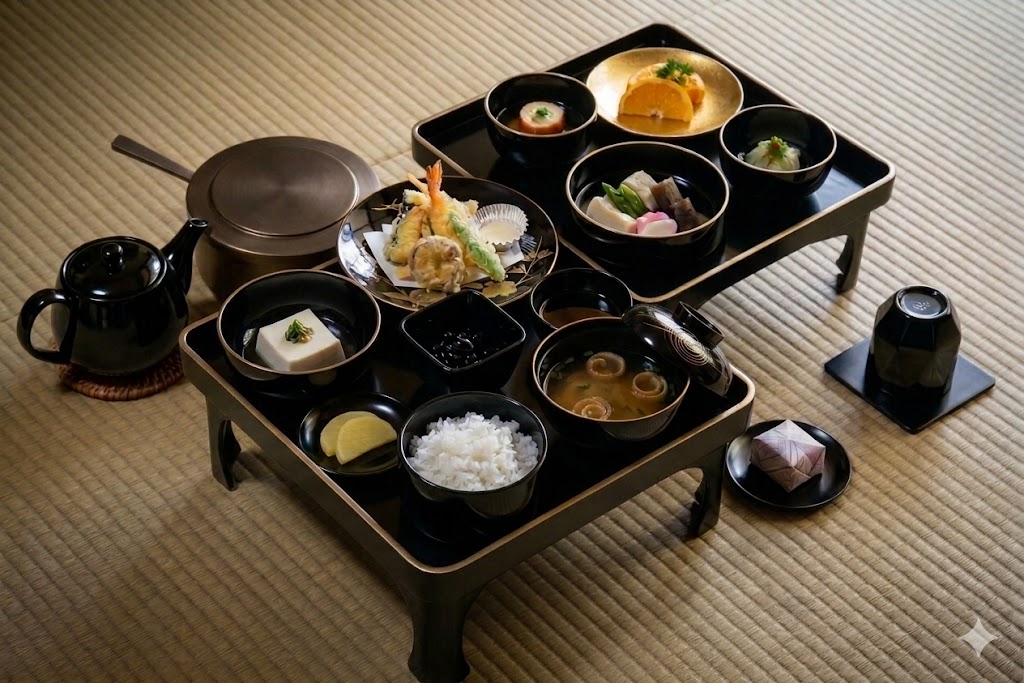
Since ancient times, as a land that welcomed pilgrims, Kumano has nurtured a singular food culture — plant-based shōjin cuisine, Nachi black rice, the mountain greens and river fish of Hongū, and the citrus and sanshō pepper of the Kii Peninsula. These are not mere "regional cuisine" but the spirituality of shinbutsu shūgō, harmony with nature, and reverence for the myriad deities — crystallised in the form of food. A cultural treasure without parallel in the world.。
Yet its true value has not been adequately conveyed to the world.
This project will appoint a globally recognised chef as culinary advisor (TBC). We will reconstruct Kumano's local ingredients and Japan's shōjin tradition as world-class gastronomy.
Jabara, budō sanshō, Hongū plums, Kishū mandarins, local rice, mountain greens, river fish, game — reinterpreting Kumano's materials with the techniques and sensibilities of French, Nordic, and contemporary Japanese cuisine. Through direct partnership with local producers, we secure traceability and fair returns.
The thought and technique of shōjin cuisine — long served to purify body and mind before and after worship — retranslated for contemporary vegan and religious-dietary needs (halal, kosher, vegetarian). A new form of shōjin that answers the world's culinary diversity.
Seasonal menus that resonate with the festival calendar of Kumano Hongū Taisha, the four seasons of the Hongū region, and the harvest. The irori hearth in winter, mountain greens in spring, cooling tastes in summer, gratitude for the harvest in autumn. Cuisine that breathes with the rhythm of the land.
This project will stand on its own, but ultimately set menus around the KUMANO XR experience, the meal programmes of the Kumano Retreat, and the drinks of the Jabara Shrine — woven organically together, giving meaning to every hour of "a day or a night in Kumano."
SBNR (Spiritual But Not Religious) travellers from Western nations and Oceania; returning high-end visitors to Japan; international guests requiring religious-dietary options; sustainability-minded Millennials and Generation Z, at home and abroad. Open broadly, yet reaching the right people — a dining experience of quiet dignity.
We are progressing in parallel on assembling the expert brain trust — including a globally recognised chef — on recipe research, dialogue with local producers, and team formation. The venue and operating form are under consideration in coordination with the Kumano Retreat Project.
Translating evil into resurrection.
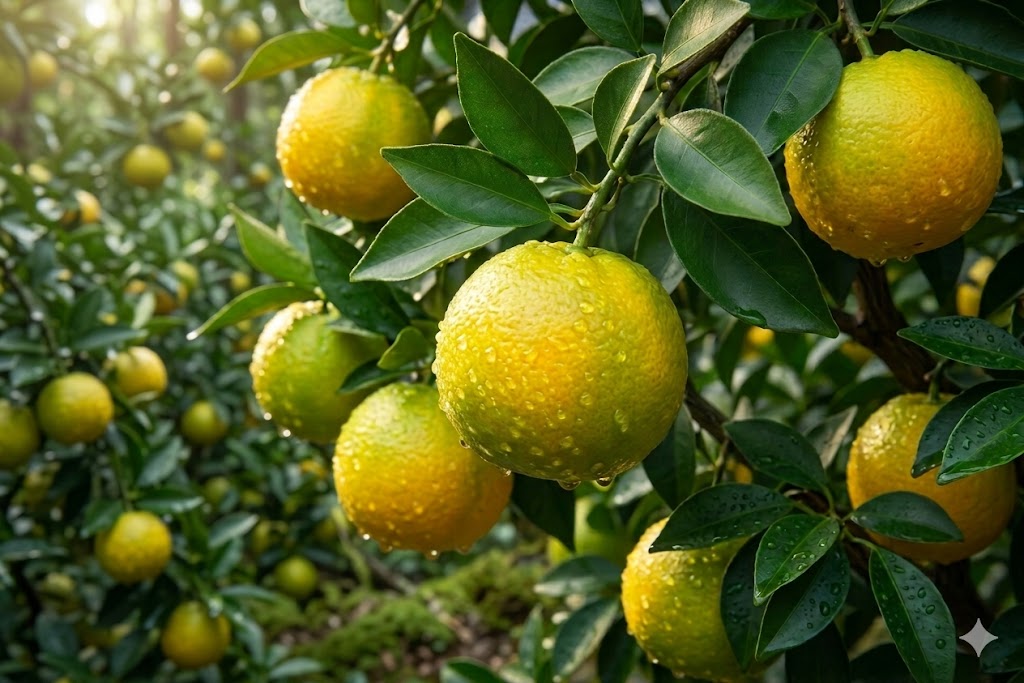
"Jabara" — its very name suggesting the warding off of evil — is a rare citrus that grows wild only in Kitayama Village, Wakayama. A natural cross of yuzu, kunenbo, and Kishū mandarin, it grows wild nowhere else in the worldthe phantom fruit. In Kitayama, it has long been treasured as a New Year's auspicious food; its name, it is said, comes from a sharpness so commanding that even oni — demons — would flee.
Bearing the name "to drive away evil," this fruit resonates deeply with the spirituality of Kumano — shinbutsu shūgō, purification, and yomigaeri.
At the Jabara Shrine, drink A Cup of Resurrection. — Purification and rebirth, in a single cup.
Yashiro means a sacred place. Not a mere stand, but positioned as part of the sacred precincts of Kumano Hongū Taisha. The English name Jabara Shrine conveys, to pilgrims from the West, the nuance of a small sacred place — intuitively.
Kumano has long been called "the sacred land of yomigaeri." The word's origin is yomi-gaeri — to return from yomi, the land of the dead. "Yomigaeri no Ippai" condenses this concept into a single cup. After comparing Revival and Rebirth, we adopted "Resurrection" — the same word used in Kumano Hongū Taisha's official English presentation.
The sales location is an integrated café with the KUMANO XR reception area before the Ōyunohara great torii. A meditative, dignified place to pause — before or after the XR experience.
Located naturally on the path of XR participants, it minimises the cost of building a separate flow while maximising its value as a place where, during waiting or in the after-resonance of the experience, body and mind are tended by the gifts of the land, and the story is carried home. It is also independently open to general pilgrims.
The core product is a non-alcoholic craft drink made from jabara. Through direct partnership with the Kitayama producer (Jabaraiz Kitayama Co., Ltd.), we ensure stable supply of the rare ingredient and a fair return to growers.
Drinks only, at approximately JPY 500–700. This preserves the ease with which a pilgrim or XR participant might quietly stop by, while offering value commensurate with the rarity of the ingredient and the story of Kumano.
KUMANO XR participants (an estimated 24,000 per year) — natural visits before and after the experience
General pilgrims visiting Kumano Hongū Taisha and Ōyunohara (a portion of the 1.61 million annual visitors)
Inbound pilgrims from Western nations and Oceania (80–90% of Kumano Kodō Nakahechi hikers are foreign visitors)
Sustainability-minded Millennials and Generation Z, at home and abroad
From this project too, as with KUMANO XR, a structure for returning value to the region and to Kumano Hongū Taisha is embedded. We plan to offer graduated dedications to Kumano Hongū Taisha, calibrated to volume and revenue. As the business grows, so does its contribution to the shrine — a sustainable circular design.
Cups, straws, and the like are to be made of environmentally considerate materials wherever possible. We commit to a dignified operation that does not compromise the World Heritage landscape or the sacredness of the precincts.
Translating the walking culture into a stay.
What kind of lodging suits a traveller of the Kumano Kodō? Not opulent interiors, nor excessive service. For the pilgrim who sets out at dawn and accepts a forty-kilometre mountain walk, lodging must be a quiet, dignified place that supports the very act of walking and the time of prayer toward the sacred land.
What Kumano has long cherished is not the richness of price, but the richness of experience.
This project designs a new form of stay that resonates with the spirituality of the UNESCO World Heritage Kumano Kodō. Through respect for the walking culture, harmony with nature, and a culturally rich stay — beyond the measure of wealth — we offer an experience in which "the time spent in Kumano" becomes a treasure for life.
We use the word "retreat" because its origin lies in "a withdrawal for rest, seclusion, and dialogue with oneself" — which deeply resonates with what Kumano has long served as: a place of the soul's rebirth.
We seek architecture in harmony with the landscape and spirituality of Kumano Hongū Taisha. Use of local materials and other respect for the World Heritage landscape are paramount.
Excessive decoration is set aside. The space is designed to make the most of the beauty of negative space in traditional Japanese architecture, natural light, the turning of the seasons, and the sounds of river and forest.
The KUMANO XR experience, a guided walk on the Kumano Kodō, formal worship at Hongū Taisha, the gastronomy, A Cup of Resurrection at the Jabara Shrine — integrated with our other projects to design a full-course "Kumano stay." The lodging is not merely accommodation but the hub of the entire stay.
One key principle we share with the Kumano Tourism Bureau is Residence First — residents come first. To ensure that residents' lives are not compromised by tourism, the scale, placement, and operating policy of the facility will be determined through dialogue with the local community.
Planning is centred on a parcel that faces the great torii of Kumano Hongū Taisha. Historically, this land was among the candidate sites considered for the relocation of Hongū Taisha after the great flood of 1889 — a symbolic place.
SBNR travellers from Western nations, Oceania, and Asia; high-end returning visitors oriented toward culture, history, and spirituality. We do not pursue the mass market. We build relationships slowly with deeply resonant guests, through word of mouth, introductions, and a small number of high-quality publications.
We are advancing on concept design, the coordination of basic agreement on the candidate site, and the selection of architectural and operating partners. The specific opening date, number of rooms, and price range will take concrete form in step with the KUMANO XR Project.
The four projects are independent, yet bound by a single brand sensibility — "Translating Japan to the world."
A visitor first encounters, through KUMANO XR, the lost landscape; then, at 邪払の社, drinks A Cup of Resurrection; tastes the land through ガストロノミー; and at リトリート, reflects on all of it. We offer the Kumano experience — a day, a night, or several days — as a single weave.
This is not tourism. It is a new form, for our time, of the Kumano pilgrimage.
In particular, KUMANO XR and the Jabara Shrine are planned to open at the same site — before the Ōyunohara great torii — simultaneously in April 2027. The integrated operation of the HMD reception area and the Jabara Shrine café delivers both visitor convenience and operational efficiency.